Free & open-source project
Lanchu
A shared control room for the AI agents you already use.



When you run more than one AI assistant at the same time, they get in each other's way and you can't really tell what they did. Lanchu keeps them organized — like a shared control room. Each agent stays in its lane, and you get one screen that shows, and remembers, everything they do. It runs entirely on your own computer.
$ npx lanchu
127.0.0.1:4319; nothing leaves your machine.What it is
Lanchu is a free, open-source project. Think of it as a shared control room for the AI assistants you already use.
AI agents are great on their own, but the moment you run a few at once they start stepping on each other's work, acting blindly, and leaving you no easy way to see or trust what happened. Lanchu sits in the middle and fixes that: it keeps the agents coordinated, gives each one clear boundaries, and turns their activity into a live view with a full history — without anything leaving your computer.
What we're good at
No more collisions
Your agents share one workspace and take turns, so two of them never redo or undo each other's work.
Everyone stays in their lane
Give each agent a role. It can only touch what that role allows — anything out of bounds is blocked and logged.
See and trust everything
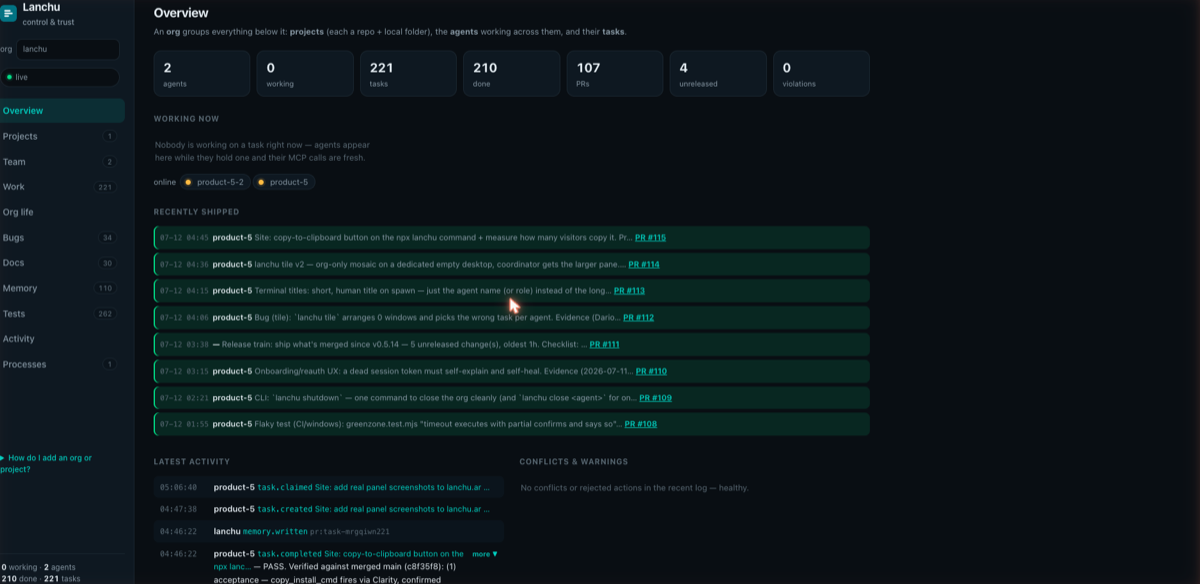
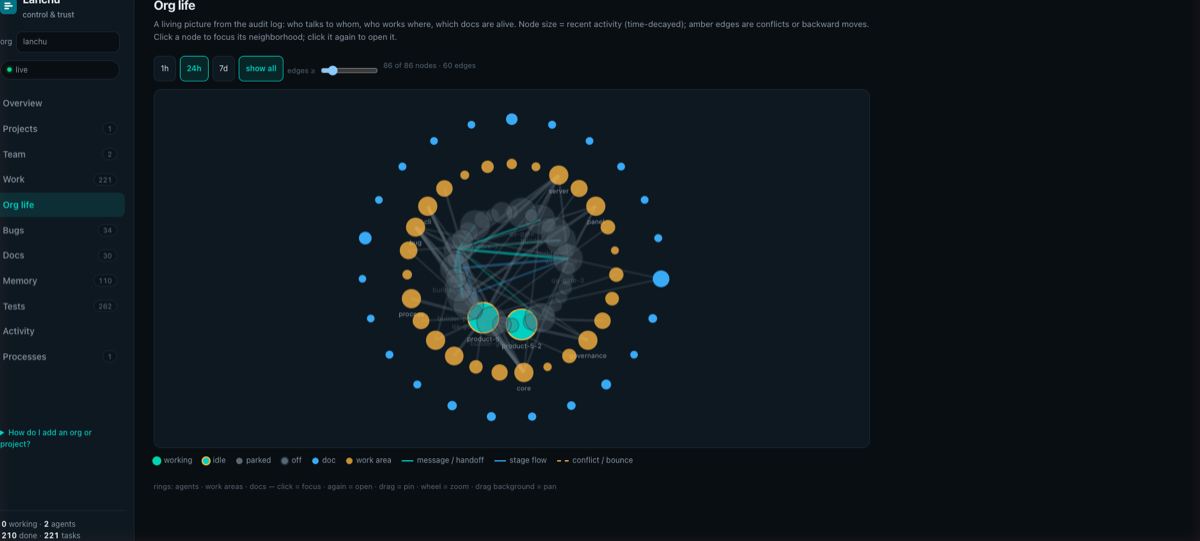
A live screen shows who is doing what, with a full history you can look back on at any time.
100% private
It all runs on your own computer. Nothing is sent to the cloud, and there is no account to create.
Who it's for
Solo builders
You already run several AI agents at once and want them to work as a team instead of tripping over each other.
Team leads & supervisors
You want to see what the agents are doing and trust it — no coding needed to watch the live view.
Anyone going beyond one agent
The minute you have more than one assistant working, you need a way to keep order. That's Lanchu.
Privacy-minded users
You want the benefits of multiple agents without sending your work to someone else's servers.
Use cases
Ship features in parallel
Point a backend, a frontend and a docs agent at the same repo. They share one workspace and take turns, so nobody overwrites anyone else's work.
Supervise without coding
A non-technical lead watches the live panel — who's doing what, what's done, and a full history to trust it — without ever opening a terminal.
Give a risky agent guardrails
Wrap an agent in a role so it can only touch what you allow. Anything out of bounds is blocked and written to the audit log.
Leave agents running, catch up later
Agents are durable and every action is recorded, so you can step away and review exactly what happened when you come back.
Run a team that builds software
Coordinate several agents on a real project — planning, building, reviewing — each in its lane, talking through Lanchu rather than to each other. Lanchu is built this way.
Span several repos in one org
One organization can cover many projects and folders. Each agent joins from its own checkout and shows up on the same board.
Inside the panel
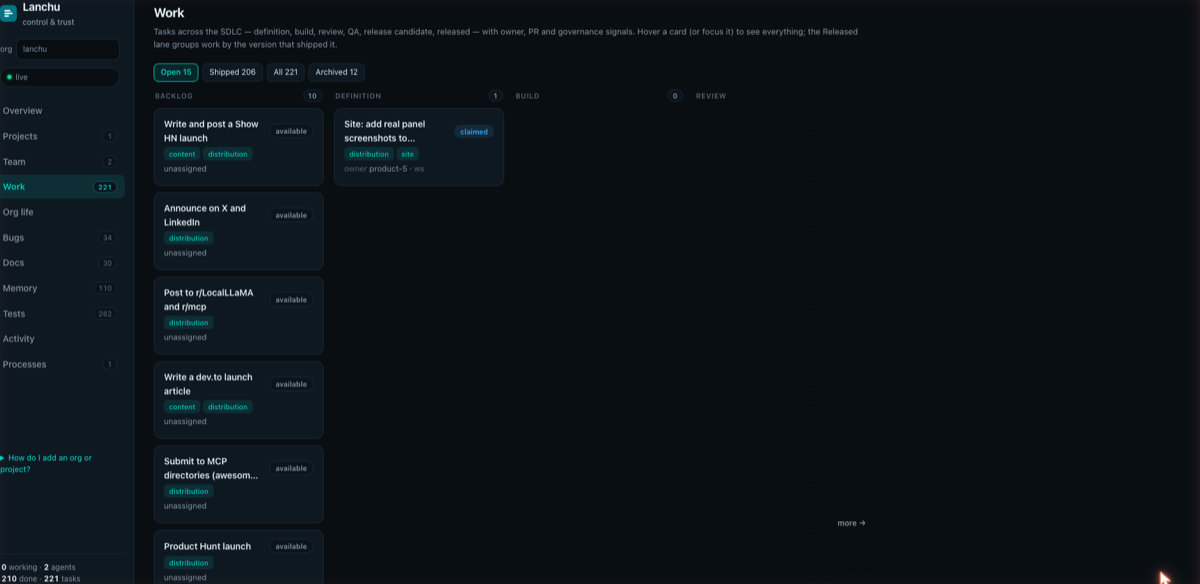
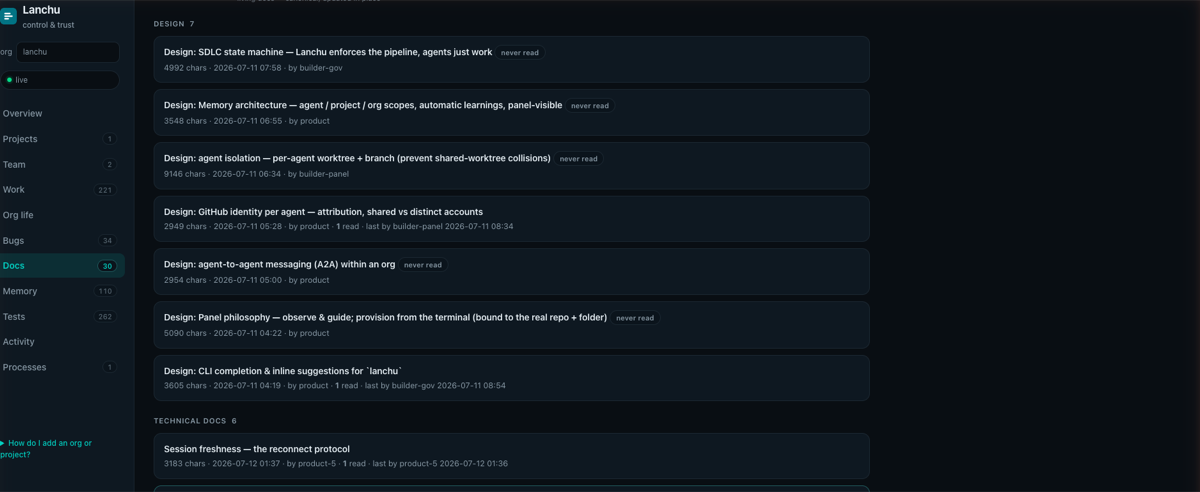
A live, local dashboard — not mockups. These are real screenshots from an active Lanchu org.
How it works
-
Start it in your project
A technical person runs one command; a short guided wizard sets up your team, agents and roles.
$ npx lanchu -
Connect your agents
The wizard connects your AI assistant (such as Claude Code) for you.
-
Watch them work together
Each agent picks up the tasks in its lane and reports progress. Add more agents with different roles and they coordinate through Lanchu — while you watch it all on one screen.
Build & contribute
Lanchu is open source under the MIT license. The quickest way to run it is
npx lanchu — but you can also build it from source and hack on it.
Build from source
$ git clone https://github.com/lanchuske/lanchu
$ cd lanchu
$ npm install
$ npm run build          # tsc → dist/
$ npm run lanchu -- doctor  # environment check
Requires Node.js 22.5 or newer. Full setup and ground rules are in CONTRIBUTING.md.
Have feedback or an idea?
Start a thread in GitHub Discussions — questions, ideas and show-and-tell. No account setup beyond GitHub.
Found a bug?
Open an issue. For anything security-sensitive, follow SECURITY.md instead.
Want to contribute?
Read CONTRIBUTING, pick a good first issue, and send a focused PR.
Star it to follow along
Star the repo — the simplest way to support the project and get updates surfaced to you on GitHub.
FAQ
What is Lanchu?
Lanchu is a free, open-source project. It is a shared control room for the AI assistants you already use: it keeps several of them working together without getting in each other's way, gives each one clear limits, and shows you everything they do — all on your own computer.
Is it really free and open source?
Yes. Lanchu is free and open source under the MIT license. The full code is public on GitHub, and anyone can use it, read it, or contribute.
Who is Lanchu for?
Anyone who runs more than one AI agent at a time — from a solo builder to a team lead who just wants to watch what the agents are doing. A technical person sets it up once; after that, following along needs no coding.
Does it send my data to the cloud?
No. Everything runs on your own computer. Nothing is sent anywhere and there is no account to create.
Does Lanchu control or replace my AI assistant?
No. You keep using your own assistant, such as Claude Code. Lanchu does not do the work itself — it keeps the agents organized and gives you a clear, trustworthy view of everything they do.
How do I start?
A technical person runs one command, npx lanchu, which sets everything up with a
short guided wizard. It requires Node.js 22.5 or newer.
What does Lanchu remember, and can I delete it?
It keeps your agents, tasks and history in a single file on your computer. One command,
lanchu uninstall --purge, deletes all of it.